


The Hamstrings
Don't pull a hammy!!!!

HAMSTRINGS =
Yup the ol' hamstrings. Really a bunch of individual muscles, but I thought I would introduce them as a group. Nobody goes to the gym and says they're gonna work out their biceps femoris today. In fact, nobody says "It's hamstring day!" either. Weird.


I bet you're wondering why call them "hamstrings." Is it because human flesh looks and tastes a lot like pork flesh??? Unfortunately, no. According to Wikipedia the name comes from some old English word "ham" or "hom" meaning the hollow crooked bend in a tree with the "strings" obviously referring to the tendons behind the knee that feel like cords.
That hollow place behind your knee is actually called your popliteal fossa, and it houses all kinds of important stuff. The medial and lateral borders are those hamstring tendons and between is an important highway of nerves and blood vessels that supply the lower leg. This location behind the knee offers some protection from major injury to these essential structures.
If you put your hand back in the popliteal fossa you will feel three distinct "strings" or tendons. The outer tendon, by itself, belongs to the biceps femoris. While the pair of tendons on the inner aspect are the semimembranosus and semitendinosus from medial to lateral. In between you can probably find a pulse on your popliteal artery.
HOW TO AVOID PULLING A HAMMY
Hamstring injuries are incredibly common and notoriously hard to rehab. We've all probably felt it, and it's disappointing to see your favorite athlete go down clutching their hamstrings because you know it might be weeks before they are on the field again (except for soccer players who are sometimes miraculous healers after being carried off the field on a stretch). So what is this injury and how can we avoid it?
Simply put, it is a strain or a tear of one or more of the hamstring muscles. Well, duh. There are three grades from a simple cramp in the muscle (which can be a local build-up of lactic acid or other local electrolyte abnormality that causes pain) that is relieved with rest and time to a full tear of one or more of the muscles with the two pieces of the muscle contracting up into a ball on either side of the gap in the muscle. The latter is accompanied by a lot of bleeding which will for a bruise as well as muscle deformity. Mostly what we are talking about when referring to a "pulled hamstring" is on the lower end of the spectrum from a local cramp to a minor tear.
Here are some things you can do to avoid this dreaded injury...
Warm-up. Most hamstring injuries occur when in a full sprint. Here the hamstrings are working at rapid speed under full stretch with near maximal contractions. This is much different than a simple walk or slow jog. The range of motion of the knee is so much greater in a sprint than in a walk with the knee flexing so much, sprinters look like they are kicking their own butts. This high speed of contraction and range of motion cannot be accomplished without maximal blood flow to the muscles. "Warming up" means gradually contracting the muscles up to game speed in order to dilate blood vessels. A "warm" muscle is both more pliable to handle the stress and has more blood flow to deliver oxygen and clear lactic acid. Warming up really does help.
Stretching. From a mechanical stand point probably not all that helpful in preventing an injury right before you exercise. Think about it. Proper stretching causes microtears in the connective tissue of the muscle, that when repaired, result in a longer muscle at rest. This is probably not what you want to do right before stressing the muscle and hoping that you don't partially or fully tear your hamstring in a dead sprint. That's not to say stretching doesn't help, just don't do it right before you play. As mentioned, normally your hamstrings do not go through the full range of motion of a full sprint during your day-to-day activities which usually involve a lot of sitting with knees flexed. This is a very shortened position for your hamstrings and they may not like the full hip and knee extension that comes with the long strides of a fast break. Flexible hamstrings are good because they are ready for activities. Weekend warriors shouldn't be surprised when they injure their hamstrings after a sprint after sitting all week.
Strengthening. Your hamstrings do not bear weight or need to contract very hard under walking conditions. There they are responsible for breaking the knee swing and little contraction at push-off. When sprinting, on the other hand, the hamstrings have to eccentrically contract to slow the rapid knee extension (from the quads) and then as soon as the foot hits the ground rapidly contract the knee to pull the ground with the foot as well as a contract so the hip extends pulling the body weight over the hips. It's eccentric contraction followed by concentric contraction at much faster speeds than you would ever asks your biceps brachii to do with your body weight and velocity to contend with. Imagine doing (arm) bicep curls as fast as your knees flex when you run. Allt this velocity and mass equals huge forces acting on the contracting hamstrings when running. This means strong hamstrings are a must if your sport involves sprinting. Just asking your hamstrings to handle that load once a week is too much.


Gluteus Medius
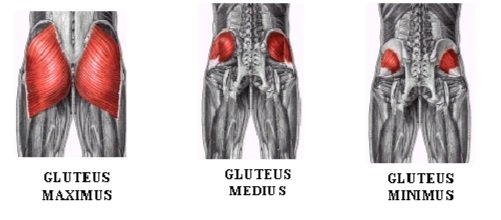
Brought to you by peakfatlossandfitness.com/glute-exercises where you can find a book I wish I had penned, Gluteus to the Maximus.
In the middle...

I'm terrible at the half-moon yoga pose. Try it for yourself. You'll quickly feel the burn. Now, keep holding it. If you're anything like me that muscle that is screaming is the gluteus medius.
Just peaking out from under the gluteus maxiumus, you just might be able to feel it flex under the part of the pelvic bone called the iliac crest. This is where the "glute med" originates, as you can see looking at the backside of anatomical models above. It inserts on the greater trochanter at the top of the femur, as you can see in the rotating model above. By pulling the greater trochanter closer to the iliac crest the leg is moved in an action called, abduction.
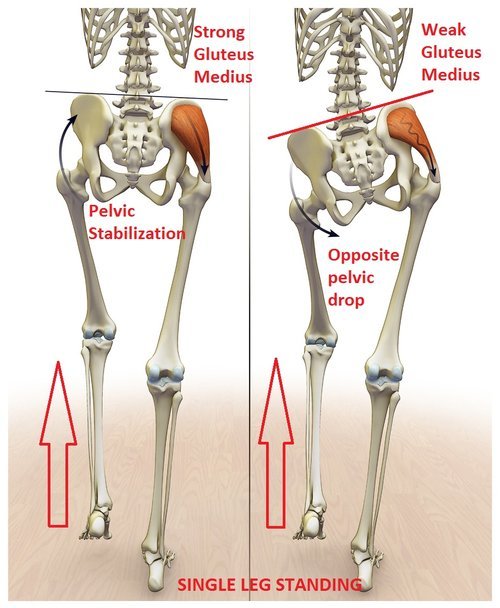
You can try hip abduction for yourself in a movement easier than the half-moon. Stand up with your feet together, toes pointing forward. Now shift your weight to the left leg, only lightly touching your right toes to the ground. You're already engaging your left gluteus medius so long as your hip stays level to the ground. Now take it a step further and raise your right leg to the side, and you will feel your right gluteus medius engage. As usual, with the body, your muscles are made to function in tandem, add to that the fact that many of the body's "overlooked" muscles are the stabilizers (see rotator cuff muscles of the shoulder).
Without stabilization of your hips, those impressive movements like running and jumping are just not possible. You will not be able to transfer your weight and push off the ground if your spine is flopping around. Hips and core need to stay rock solid to (just like in yoga!) in order to perform any single-leg activities. Furthermore, lots of athletic movements are side to side (lateral movement in the frontal plate), but the vast majority of what we train in the gym is only movement in the sagittal plane (i.e. front to back, think squat or deadlift).

If we are only moving our hips in the sagittal plane (flexion and extension) with squats and leg presses, then we are likely to have weak hip abductors (like the glue medius). The adductors and abductors allow you to shuffle your feet in a defensive slide in basketball. In addition, to supporting the hips in the deadlift, the abductors are the prime movers in side-to-side movements.


Which brings us to the workouts...
I suppose you could be like this fellow to the right and perform some hip abduction with a cable machine, but I think the exercise band wrapped around the knees is more versatile. Start with performing squats with the band around your knees while you resist adduction. This could also be used in your warm up before doing squats and will help you keep good form.
Isolating movements with the band include the aptly named fire hydrant and clam shell exercises seen above. I think you can figure out which is which. Of course, as mentioned at the top, many yoga poses with the hips perpendicular to the ground, like half moon, include resisted hip abduction.
Also, check out Chad Waterbury's Build Your Glutes Fast! page for exercises and for even more nerdy stuff, read his Glute Training Science page to get some EMG data, etc.
What I would most recommend for the athlete, is adding the band around the knees for many of your sport's specific movements. This might mean defensive slides in basketball or cross-court shuffle in tennis. If you can perform these well with the band, you will feel the difference in games without it.

The Glutes
What I find amazing is this concave structure of the posterior pelvis you see rotating above is filled in with all these muscles to make it convex, sometimes impressively convex!!! Although some of this might be due to unlucky, or lucky, fat deposition, for many athletes it is due to good ol' hard work and muscle hypertrophy.
There's a lot more to learn about these glutes, and simple internet search told me that there is a lot of interest out there. Which brought me to getglutes.com because, of course, this exists.
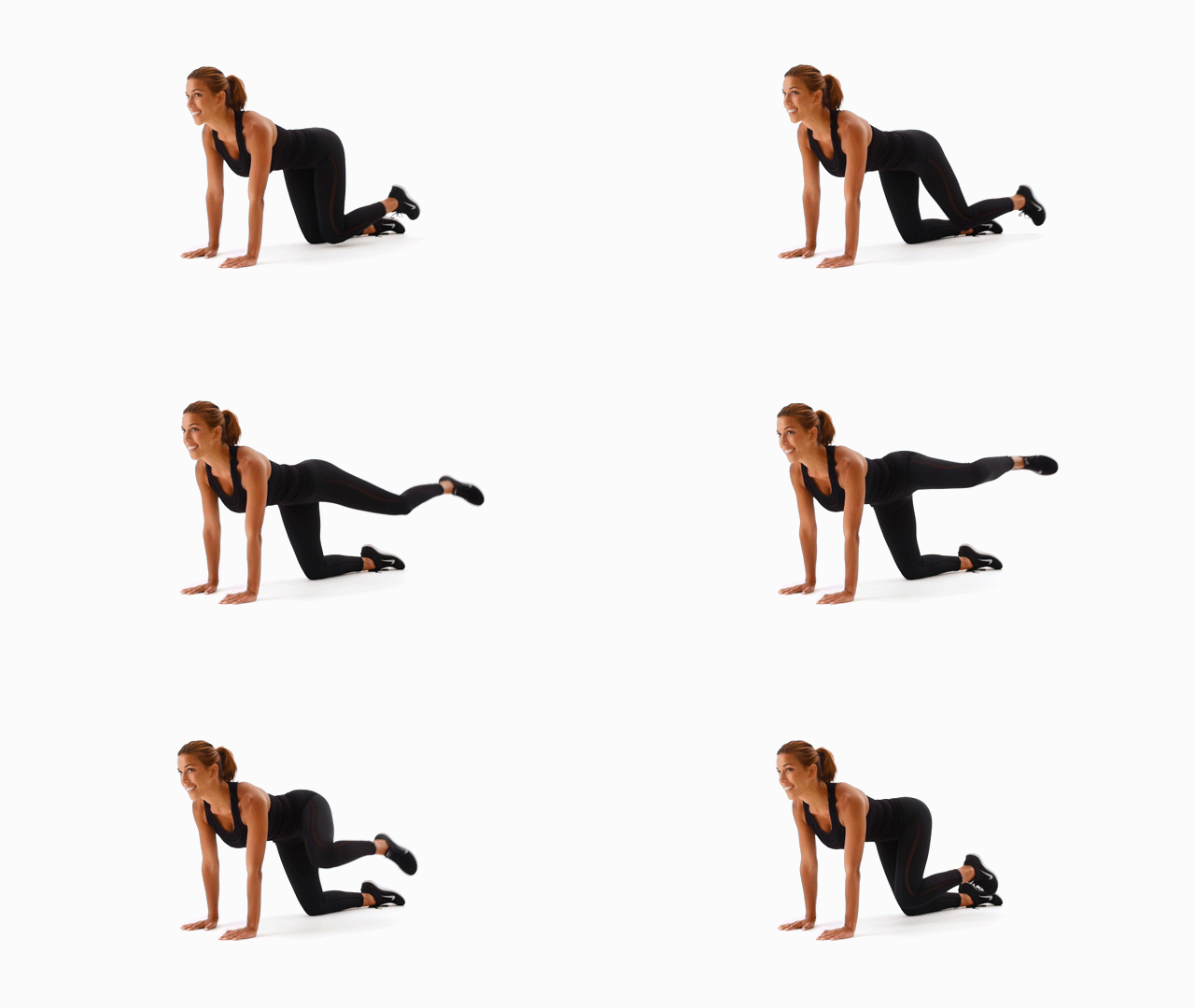
Needless to say, there is a lot of material on YouTube aimed at improving "form" far more than function. So let's get back to function and the form can just follow. What all of these workout videos have in common is trying to maximally activate and contract the gluteus muscles over the quadriceps. As I mentioned previously, many of us are quad dominant, meaning that we activate the knee extensor muscles with squats and deadlifts, running and jumping, over the hip extensors.

First, lets meet the players, the gluteal family. We've already met gluteus maximus and this is our primary hip extensor. The hamstring muscles will also play a role in hip extension, but because they cross two joints they also famously flex the knee. As mentioned the glute max however, just crosses one joint and it's purpose is there. Now we can see from its fiber orientation, that it doesn't just work in one plane. Shortening of the gluteus maximus will result in hip extension and some external rotation. Now, most of what we talked about thus far are compound movements or exercises, like squats or deadlifts or just jumping over 7 footers. In these movements the gluteus maximus works in concert with other muscles to produce the movement, so its line of pull is primarily hip extension, usually without hip external rotation. If you did the workout last week, however, there was a combination of compound movement and isolating exercises that included both hip extension and external rotation (like this awkward exercise no one will ever do at a crowded gym).
These isolating exercises are nice to fatigue the muscles (and maybe wake up that sleeping glute), but they hardly tap into the powerful potential of the glutes. The best way to exercise any muscle is to put it on stretch and then contract through full range of motion. As mentioned, however, we don't like to do this and tend to cheat with our back when we do go into hip flexion.
My tip is this: When performing your deadlifts or squats, push your hips back to get more flexion, drive your heels into the floor rather than going onto your toes and using more quads, and finally, squeeze the glutes at the top by adding some extra hip extension. Ok, so maybe Athlean-X has the same tip. So as Jeff says, go do some real step-ups where you start in nice hip flexion, butt also ends in full hip extension.

All we're really asking of the gluteus maximus is to do it's job. For some reason, we've let it get lazy and relied on other players to do the work. Well, you can't put together a championship team, or body, unless everyone, and every muscle, is performing at their peak. One weak link and you won't be hoisting any trophies. Don't believe me? Ask Julian Edelman. At 5'10" 200ish lbs, he's not the biggest guy on the field, but he packs some power into that small frame. And you could too, if you tap into the potential of your butt ;)

Think Jules does some lunges??
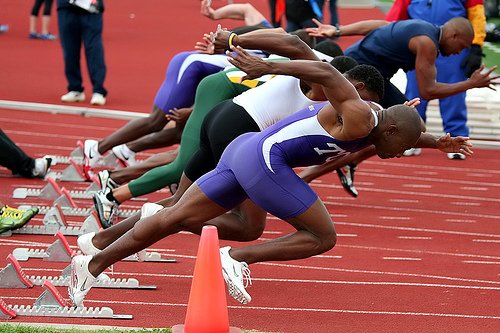
Just like the sprinters above or the dunkers from last post, Julian drives off of the line and through defenders with incredibly strong hip extension. I love all the exercises above and below that engage those glutes, but nothing beats actually performing those sport specific movements. I bet some of Julian's best workouts are game day. Sprinters have large glutes because they get on the blocks every day. Don't be afraid to get out there and run, jump, and play. As great as the science is, some of the best training is just practice, practice, practice.
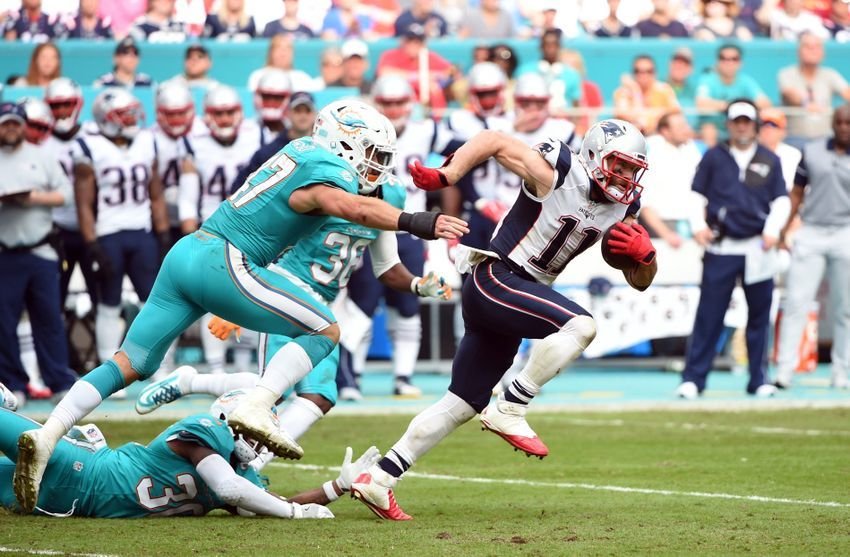
Sprint off the line in any sport with strong glutes.